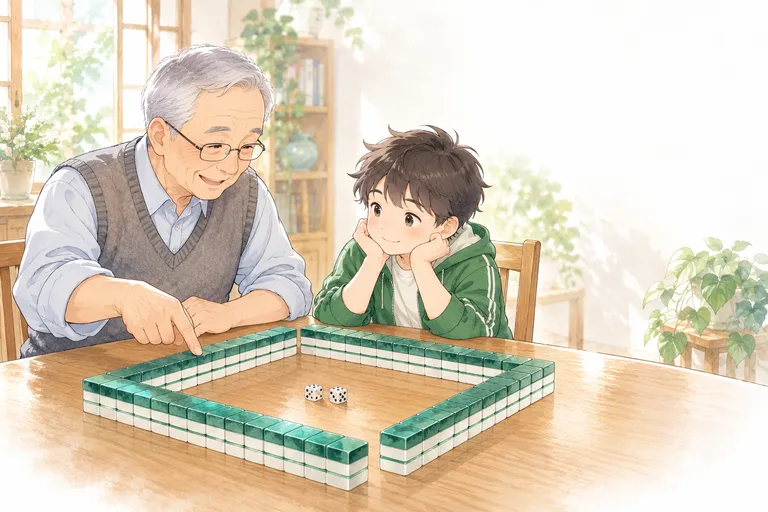
Mahjong is a tile game for four players. You take turns drawing a tile and discarding a tile, and the first player to arrange their hand into a winning shape wins the hand. It grew up in China and is now played everywhere, from Hong Kong, Taiwan and Japan to the US and Europe.
Sounds tricky? The core rules fit in a few sentences. This page walks you through the big picture.
On this page
What mahjong is
Mahjong is a game of collecting tiles into sets, a bit like the card game rummy. Each player keeps a row of tiles hidden from the others. In the middle of the table is the wall, and everyone takes turns drawing from it and throwing away tiles they don't need.
What makes it fun is that luck and skill share the table. What you draw is luck, but which tiles you keep, which you throw, and when to chase a big hand are all your call. A beginner can beat an expert on any given night, but over time the expert always comes out ahead.
The tiles: 136 to start with
A basic mahjong set has 136 tiles:
- Suits: characters, dots and bamboo, each numbered 1 to 9, with 4 of every tile.
- Honors: four winds (East, South, West, North) and three dragons (Red, Green, White), also 4 of each.
Taiwanese, Hong Kong and Guobiao mahjong add 8 flower tiles for 144 in all. Sichuan uses only the three suits, 108 tiles. American mahjong adds jokers for a total of 152. See every tile in our guide to mahjong tiles.
The goal: four sets and a pair
In most styles, a winning hand is four sets plus a pair:
- Chow: three tiles in a row in the same suit, like .
- Pung: three identical tiles, like .
- Pair: two identical tiles, like .
Four sets of three plus a pair of two makes 14 tiles. Taiwanese mahjong is the odd one out: you hold three more tiles and need five sets plus a pair.
How a round goes
- Shuffle, build the wall, and deal 13 tiles each (16 in Taiwanese mahjong).
- On your turn, draw one tile and discard one tile.
- When someone discards a tile you need, you can claim it: chow (complete a run, only from the player on your left), pung (complete three of a kind) or kong (four of a kind).
- When you're one tile from winning, you have a ready hand.
- Draw the winning tile yourself and it's a self-draw. Win on someone's discard and they "dealt in".
After a win, the hand is scored and the other players pay up.
Why the rules differ by region
Wherever mahjong traveled, it picked up local house rules. The number of tiles, the size of a hand, whether you can chow, the minimum to win and the way you score all vary:
- American mahjong: you build hands from a printed card, with jokers.
- Japanese riichi: you need a "yaku" to win, plus riichi and dora.
- Hong Kong mahjong: 13 tiles, scored in fan, 3 fan to win.
- Guobiao: the tournament rules, 8 points to win.
See all six side by side in mahjong styles.
Where mahjong came from
The game we play today took shape in China during the Qing dynasty, growing out of older card games whose cards were marked with coins, strings of coins and myriads. Later the cards became tiles of bone and bamboo. In the early 20th century mahjong reached Japan and the United States, where it became a full-blown craze in the 1920s.
As for who invented it, there are plenty of stories. One legend says the admiral Zheng He created it to keep his sailors entertained on long voyages; another credits Confucius. They're fun tales, but just legends.
Where to start
The easiest way to learn mahjong is in this order:
- Meet the tiles: learn to read every tile.
- Sets and the pair and the winning hand: know what you're building.
- A round of play and chow, pung and kong: know how to play.
- The ready hand: learn to spot the tile you're waiting for.
Each lesson is short, with pictures and a quick quiz. When you're done, head back to the home page, pick a style and play a few hands against the computer!
FAQ
Do you need four players for mahjong?
Standard mahjong is for four. There are three-player versions too, such as Japanese sanma, which leave out some tiles. On our sites the computer fills the other three seats, so you can play on your own.
How many tiles are in a mahjong set?
A basic set has 136. Add 8 flowers and you get 144, used in Taiwanese, Hong Kong and Guobiao mahjong. Sichuan uses only 108, and American mahjong has 152 with jokers.
Is mahjong hard to learn?
Not really. You can learn the tiles and the basic shapes in an afternoon. Scoring takes longer because it changes from style to style, but a few games will get you there.
What's the difference between American mahjong and Chinese mahjong?
American mahjong uses jokers and a card of set hands (the official US card is reissued every year; our site uses its own original card), and you can't chow. Chinese styles let you build any hand of four sets and a pair, then score it by its patterns.
Is mahjong gambling?
No. Mahjong is a game, and you can play for points only. Our sites are for entertainment, and every game is free practice.