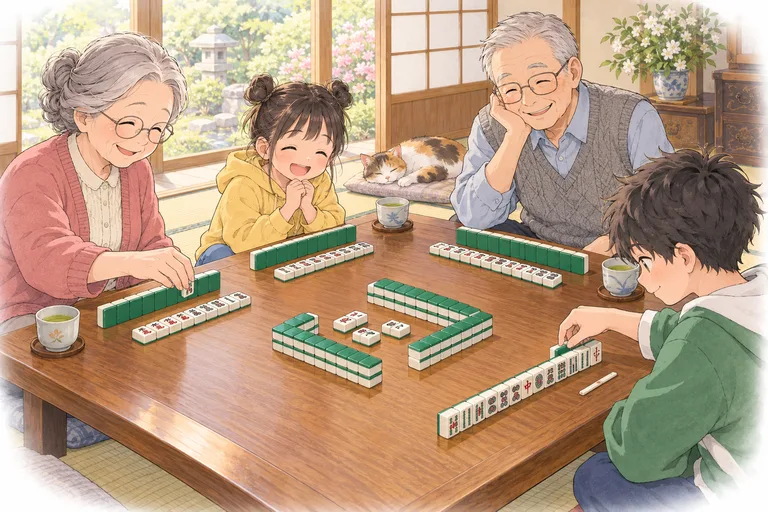
Japanese mahjong, also called Riichi mahjong, is the mahjong you've probably seen in anime and online games. Its personality: lots of rules, but every rule has a reason. A complete hand is not enough; you also need a *yaku*. When you're ready you can call "riichi", and dora give every hand a chance to grow.
On this page
What makes it special
- No yaku, no win: a yaku is a scoring pattern, such as riichi, tanyao or a dragon triplet. A complete hand without a single yaku cannot win.
- Riichi: with a closed hand (no chi, pon or open kan) that is ready, you can declare riichi and put up a 1,000-point stick. Riichi itself is a 1-han yaku.
- Dora and red fives: they add han but are not yaku, so they can't make a hand winnable on their own.
- Furiten: you can't win by ron on a tile you discarded yourself, which makes defence a real part of the game.
Tiles and hand size
The set has 136 tiles: characters, dots and bamboo from 1 to 9, plus East, South, West, North, White, Green and Red, four of each, and no flowers. By default our site makes one 5 of each suit a red five. It plays like a normal 5 but adds 1 han when you win (you can turn this off). Compare tile counts in how many tiles are in a set.
Everyone holds 13 tiles, and the dealer draws first. Each player starts with 25,000 points.
How a hand is won
A winning hand is four sets + a pair, and Seven Pairs and Thirteen Orphans are special shapes that also win. The key condition: at least one yaku.
Winning on your own draw is tsumo; winning on a discard is ron. The safest beginner route is to keep your hand closed and call riichi as soon as you're ready, which guarantees a yaku.
How scoring works
Riichi mahjong scores with han and fu: yaku and dora give han, the make-up of your hand gives fu, and together they set the points. A few examples:
| Yaku | Han (closed / open) |
|---|---|
| Riichi | 1 / closed only |
| Tanyao (all simples) | 1 / 1 |
| Chinitsu (full flush) | 6 / 5 |
| Kokushi musou, Daisangen | Yakuman |
A 1-han 30-fu ron by a non-dealer is 1,000 points; a yakuman is a flat 32,000 for a non-dealer and 48,000 for the dealer. See scoring basics for how han compares with tai and fan.
Who plays it and where
It's the rule set of Japan's mahjong parlours, pro leagues and online platforms, and thanks to online games and streaming it now has a big following in Asia, Europe and North America. There is also a three-player version, sanma.
Where to learn more and play
Visit Riichi Mahjong to play free against three AI opponents, with wait and furiten hints and a suggested discard. The site has a how-to-play guide from the deal to the win, a yaku list with the han and tile examples for every yaku, and a scoring page with the full points table.
To compare: Riichi is furthest from Taiwanese mahjong (16 tiles, flowers, no minimum), and shares the "is it worth enough?" idea with Chinese Official mahjong, which needs 8 points.
FAQ
Why can't I win with a complete hand?
Riichi mahjong needs at least one yaku to win. Dora and red fives add han but are not yaku. The easiest fix is to keep your hand closed and declare riichi when you're ready.
What is a red five?
One 5 in each suit is red. It works like a normal 5 when building sets and adds 1 han per red five when you win. Our site uses red fives by default and lets you turn them off.
Is Riichi a good style for beginners?
Yes, as long as you learn the idea of yaku. Get the basic shapes of playing mahjong down first, then remember riichi and tanyao, the two easiest yaku, and you're ready to play.