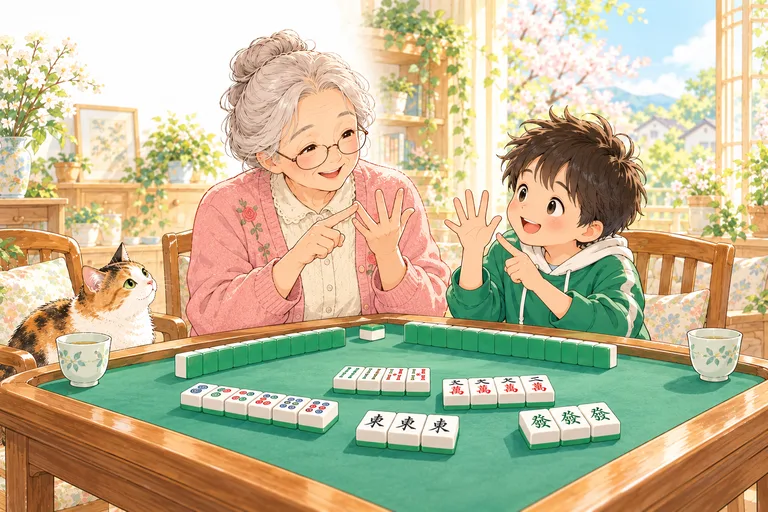
You've won. Now everyone asks: "How many fan?" or "How many tai?" Winning shapes in mahjong look much the same everywhere, but scoring is different in every style. This lesson skips the big tables and gives you the big picture.
On this page
Why scoring differs by style
Mahjong has spread around for well over a century, and every place grew its own house rules. Some like quick, small wins. Some make you build a fancy hand before you're allowed to win. American players even print a card each year and play only the hands on it.
So if someone asks "What's pure one suit worth?", the honest answer is: "Depends which mahjong you're playing."
The units: tai, fan, han and points
| Style | Unit | In one line |
|---|---|---|
| Taiwanese | tai (台) | Add up the tai of every pattern; you're paid base + tai × rate |
| Hong Kong | fan (番) | Fan convert into a payout that grows fast as fan go up |
| Sichuan | fan (番) | Each extra fan doubles the payout |
| Guobiao | fan (番) | Your fan plus a base of 8 points |
| Japanese | han and fu → points | Han (from yaku) and fu are looked up together to get points |
| American | card value | Each hand's value is printed right on the card |
No need to memorize it all. Just know which unit your style uses.
Self-draw vs. winning on a discard: who pays
There are two ways to win:
- Self-draw: you drew the winning tile yourself.
- Win on a discard: someone else threw your tile. They "dealt in" (Chinese players call it "firing the gun", 放槍).
The general rule: on a self-draw everyone pays; on a discard, the discarder pays the most.
- Taiwanese: self-draw, all three pay; discard, only the discarder pays.
- Hong Kong: self-draw, each of the three pays one share; discard, the discarder pays double and the other two pay nothing (our site's default).
- Sichuan: discard, only the discarder pays; self-draw, every player still in the hand pays.
- Guobiao: discard, the discarder pays fan + 8 and the other two pay 8 each; self-draw, all three pay fan + 8.
- Japanese: ron (discard), the discarder pays it all; tsumo (self-draw), the three split it, and the dealer pays more when a non-dealer wins.
- American: discard, the discarder pays double and the others pay the value; self-draw, all three pay double.
That's why everyone fears dealing in: one bad tile and the bill is all yours.
The minimum to win
In some styles a complete hand isn't enough. You also need to reach a minimum:
| Style | Minimum to win |
|---|---|
| Taiwanese | None: a complete hand wins |
| Hong Kong | 3 fan (our site's default) |
| Japanese | At least one yaku; dora don't count |
| Guobiao | 8 points (fan); flowers don't count |
| Sichuan | No fan minimum, but no tiles of your voided suit in hand |
| American | All 14 tiles must match one hand on the card exactly |
The higher the bar, the more you need to plan your hand early instead of grabbing whatever comes.
Hands that score in every style
Two patterns show up in almost every Chinese and Japanese style, so they're worth knowing now:
| Style | Pure one suit (清一色) | All pungs (碰碰胡) |
|---|---|---|
| Taiwanese | 8 tai | 4 tai |
| Hong Kong | 7 fan | 3 fan |
| Japanese | 6 han (5 if open) | 2 han (toitoi) |
| Guobiao | 24 points | 6 points |
| Sichuan | 2 fan | 1 fan |
American mahjong has no fixed list like this. It all depends on whether the card has that hand; on our site's card, hands are worth 25 to 50 points.
For the full scoring of each style, see its page: Taiwanese, Hong Kong, Japanese, Guobiao, Sichuan, American. When you actually play mahjong on our sites, the game scores for you, and the numbers sink in quickly.
Previous lesson: ready hand. Next, the last beginner lesson: table etiquette.
Quick quiz
What unit does Taiwanese mahjong score in?
Show the answer
Tai — Taiwanese mahjong counts tai. Hong Kong, Sichuan and Guobiao count fan, and Japan uses han and fu.
In Taiwanese mahjong you discard someone's winning tile. Who pays?
Show the answer
Only you — On a discard win in Taiwanese mahjong, only the discarder pays. On a self-draw all three pay.
What's the minimum to win in Guobiao?
Show the answer
8 points — Guobiao needs 8 points (fan) to win, and flower points don't count toward those 8.
In Japanese mahjong you have four sets and a pair but no yaku at all. Can you win?
Show the answer
No, you need at least one yaku — Japanese mahjong needs at least one yaku. Dora add han but aren't yaku themselves.