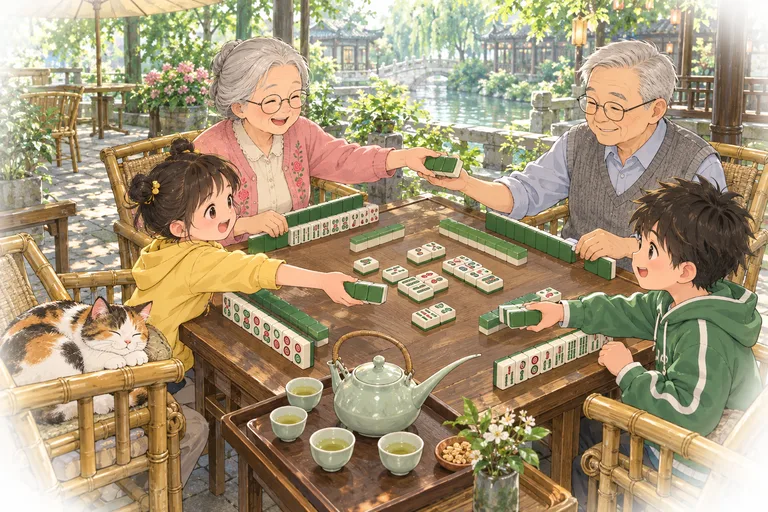
Sichuan mahjong is the loud, lively mahjong of Chengdu teahouses, and its most popular form is called "blood battle" (血戰到底). Its personality: fast, fierce and exciting. There are no honours and no flowers, you can't chow, and when someone wins the hand doesn't stop: everyone else keeps fighting.
On this page
What makes it special
- Swap three: after the deal, everyone picks three tiles of one suit and passes them to another player, in the direction the dice decide.
- Void suit: everyone declares one suit they won't keep. You must discard every tile of it before you can win, and you can never win holding one.
- Pung and kong only: there is no chow.
- Blood battle: a winner lays their hand open and sits out, and the others play on until three players have won or the wall runs out. Several players can win on the same discard.
Tiles and hand size
Only the three suits are used, characters, dots and bamboo from 1 to 9, four of each: 108 tiles, with no winds, dragons or flowers. Compare sets in how many tiles are in a set.
Everyone holds 13 tiles and the dealer starts with 14. With only three suits and one of them void, your hand has at most two suits, so one-suit hands come up far more often than in other styles.
How a hand is won
A winning hand is four sets + a pair, or seven pairs. The only extra condition: no tiles of your void suit.
There is no minimum: a 0-fan plain hand can win, it just collects less. Kongs are paid on the spot (刮風下雨). When the wall runs out, anyone still holding a void tile pays (查花豬), and players who aren't ready pay those who are (查大叫).
How scoring works
Sichuan mahjong counts fan, and every fan doubles: a win collects base × 2 to the power of fan, so 0 fan is ×1, 1 fan ×2, 2 fan ×4, 3 fan ×8. Our site caps it at 4 fan (×16) by default; 3 to 6 are options.
| Hand | Fan |
|---|---|
| Plain hand (平胡) | 0 |
| All pungs, root (four of a kind) | 1 each |
| Pure one suit, seven pairs | 2 each |
| Dragon seven pairs (龍七對) | 3 |
Fan add up, so pure one suit plus all pungs is 3 fan. For how styles compare, see scoring basics.
Who plays it and where
It's the game of homes and teahouses across Sichuan and Chongqing, and blood battle is hugely popular on mobile too. The cap and whether self-draw adds a base or a fan vary from table to table, so ask first.
Where to learn more and play
Visit Sichuan Mahjong to play blood battle free against three computer opponents, with the swap, the void suit and kong payments handled for you. The site has a how-to-play guide for beginners, a fan table with tile examples for every hand, and separate pages on the swap and the void suit.
To compare: Hong Kong mahjong also uses 13 tiles but adds honours, flowers and a 3-fan minimum; next to Chinese Official mahjong, Sichuan is far simpler.
FAQ
Why is there no chow in Sichuan mahjong?
The rules only allow pung and kong. Without chow, players lean toward all pungs and one-suit hands.
What is the void suit?
Before play, everyone picks one suit they won't keep and must discard all of it before winning. Holding a void tile means you can't win, and you pay if the wall runs out (查花豬).
What happens after I win?
In blood battle your hand is laid open and you sit out while the others keep playing. If someone self-draws later, you no longer pay. Learn the basic shapes of playing mahjong first, then dive into the battle.